Fewer export rejections, from farm to port.
EUDR, traceability and export compliance software for Kenyan avocado, coffee, tea, flower and vegetable exporters. TraceXim checks every lot, spray, test and document, and tells you before produce ships.
Free while we onboard our first customers · no card needed · already invited? Sign in
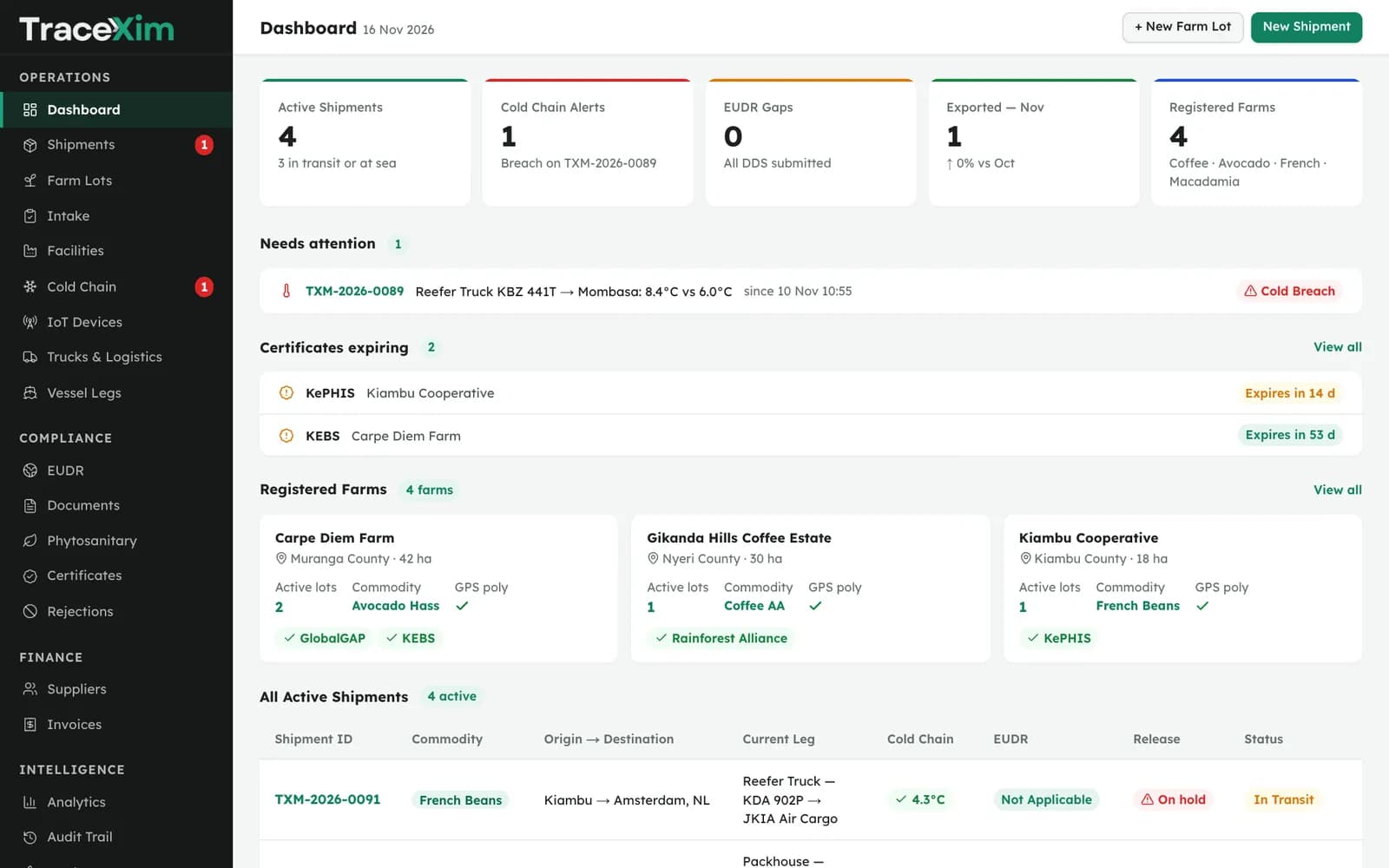
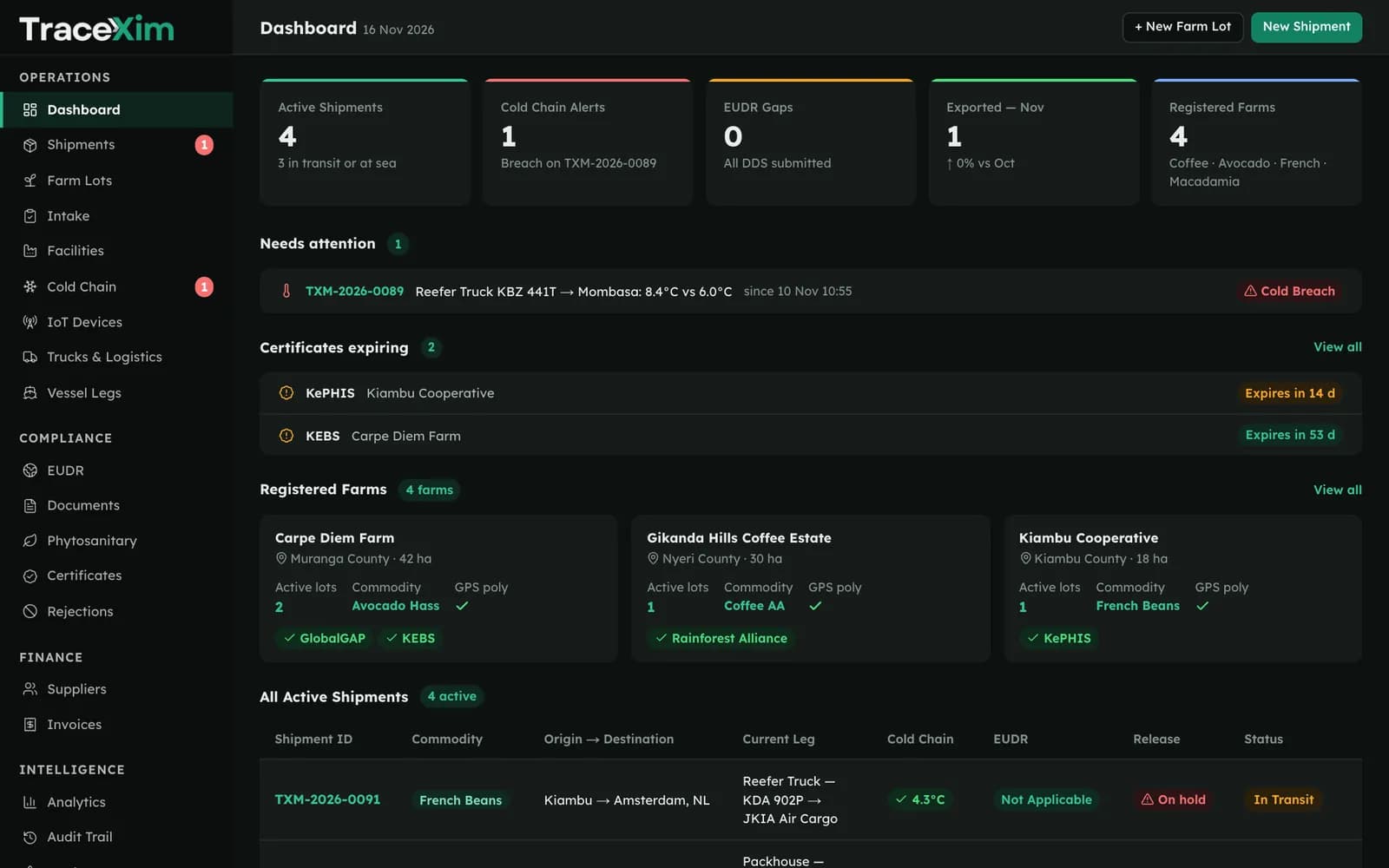
Sample data
Why shipments get rejected
Most rejections were visible days earlier
A border finds the problem in minutes. The cause was usually on a farm, in a packhouse or in a folder of paperwork long before.
Residues and pests
A spray inside its waiting period, or a lab result over the limit.
Sprays, waiting periods and results are checked before a shipment is released.
Missing or wrong paperwork
No phytosanitary certificate, no proof of origin, an expired permit.
A per-commodity, per-market checklist that ticks itself as you upload.
Cold chain breaks
A load that sat too warm for too long, with nothing to prove otherwise.
Loggers and trackers on every leg, with an alert the minute a load leaves its range.
Unclear origin (EUDR)
A buyer who cannot see where the produce was grown.
Plot boundaries on a map, deforestation screening and a due diligence pack.
How it works
Catch it at the farm, the packhouse and before it ships
At the farm
- Plot boundary drawn on a map
- Sprays and waiting periods recorded
- Harvest lot created in seconds, even offline
At the packhouse
- Kilos received and rejected, with a photo
- Pests and reject reasons logged
- Residue test results attached
Before it ships
- Green, amber or red release check
- Certificates and permits complete
- Cold chain monitored on every leg
Release check
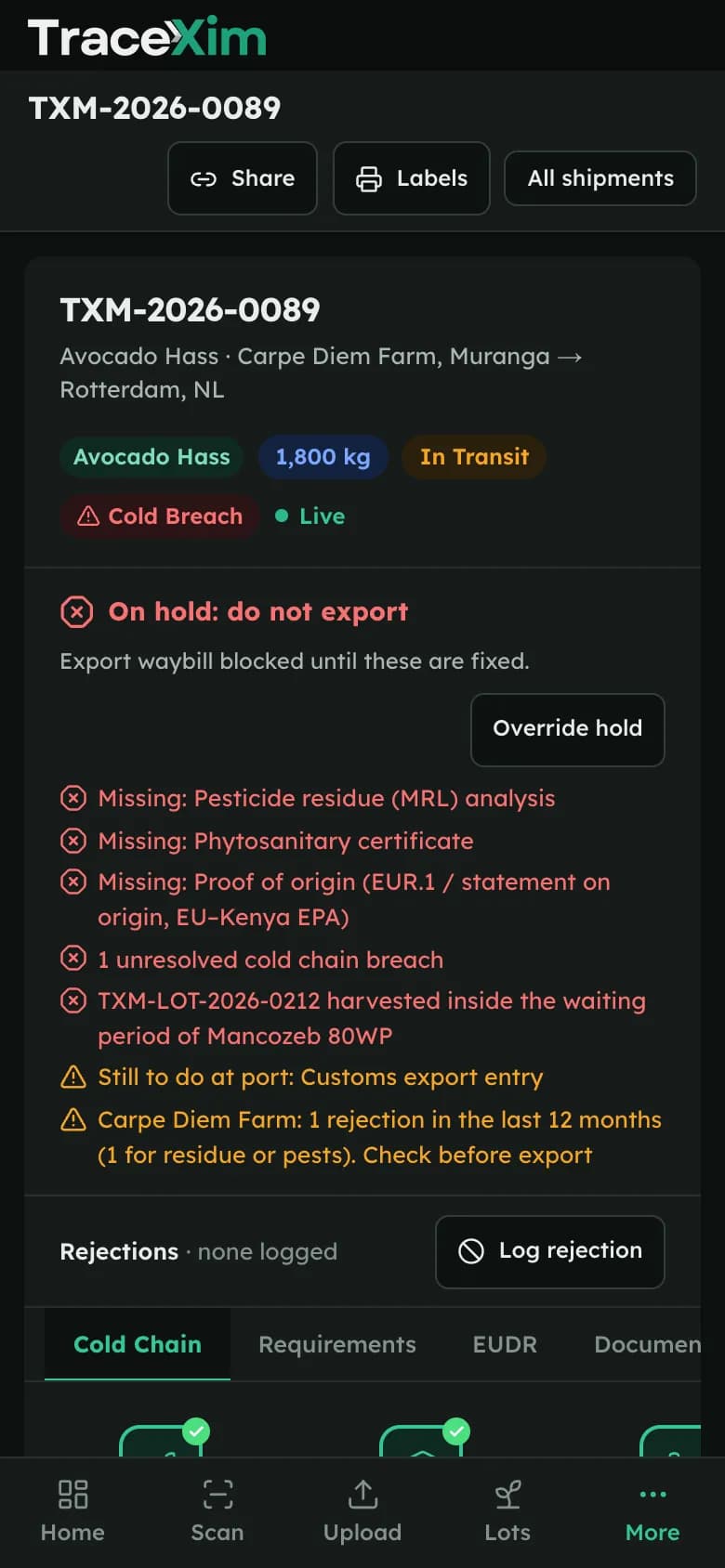
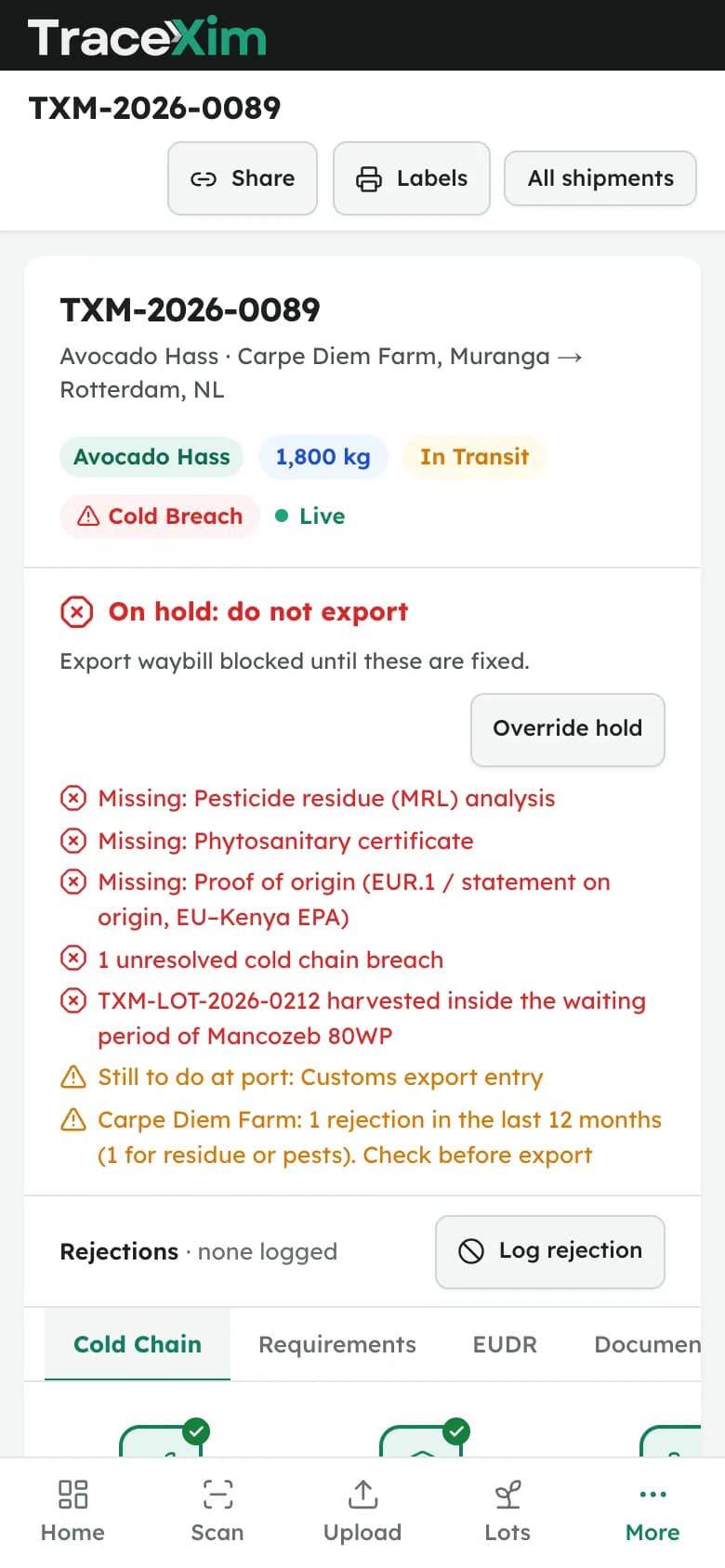
A green, amber or red answer before every export
A failed residue test, a missing certificate, a spray inside its waiting period or an unresolved cold chain breach holds the export waybill until it is fixed or signed off by the right person.
- Plain reasons, not codes
- Override needs a named person and a reason
- Every decision is in the audit trail
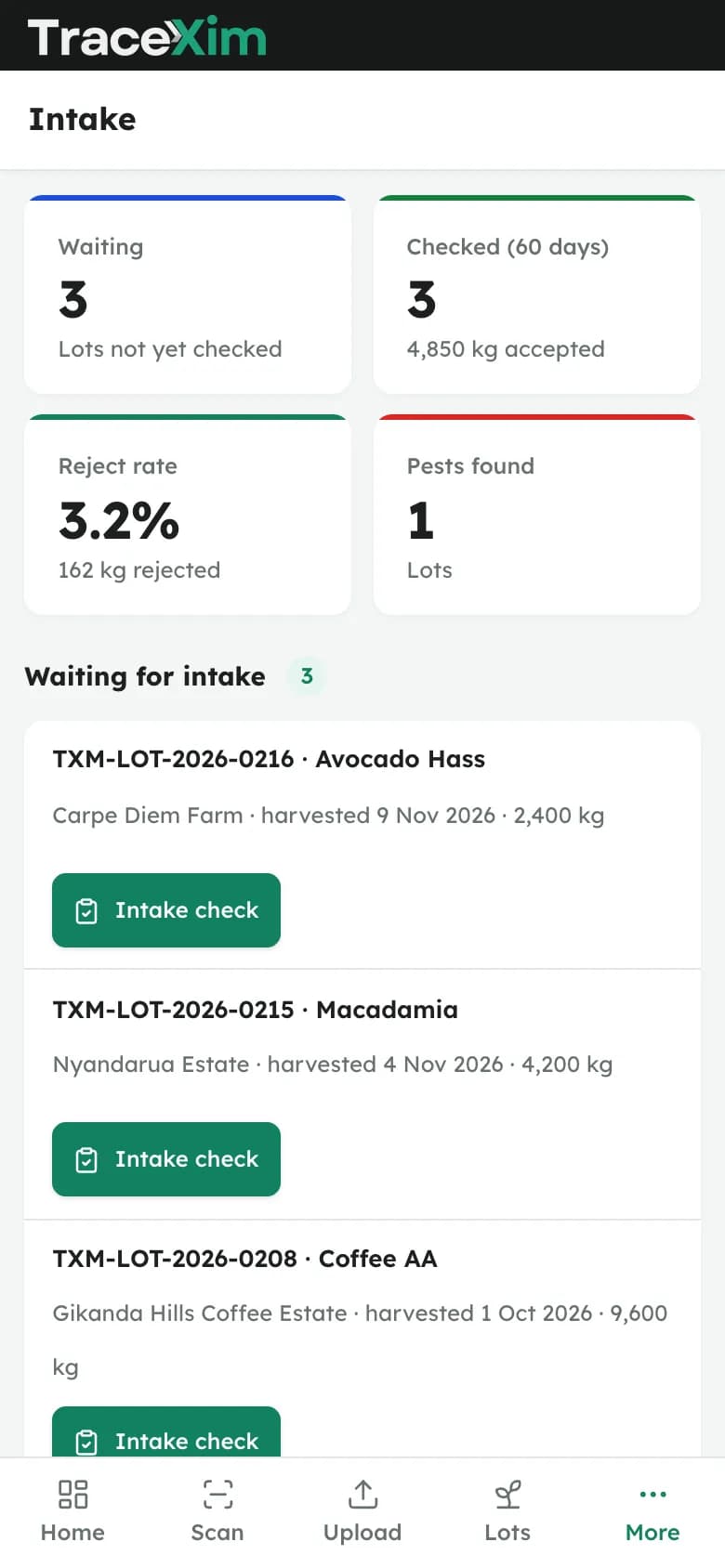
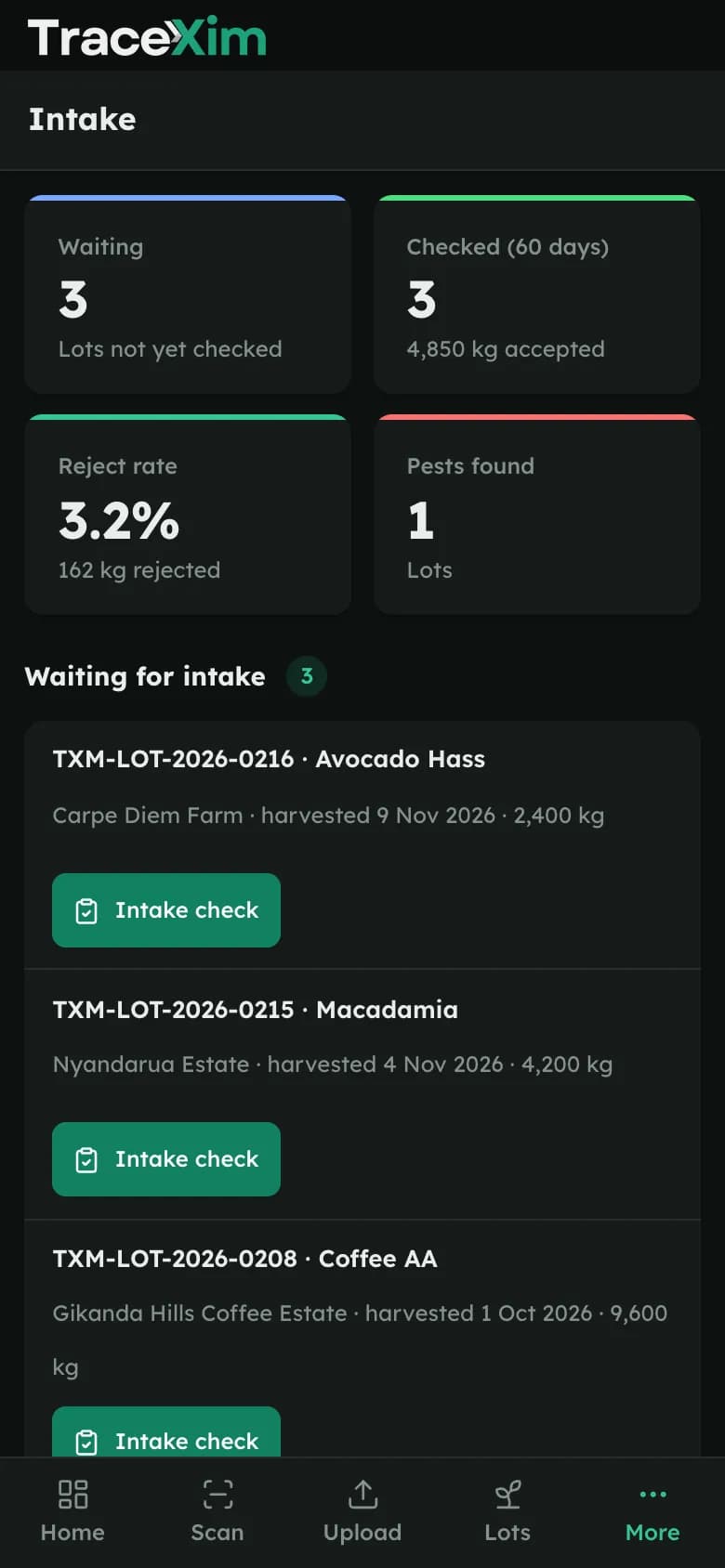
Packhouse intake
Check produce as it arrives, on a phone
Record kilos received and rejected, why, and a photo. Reject rates and pests feed straight into the farm's scorecard and the release check.
- Works offline and syncs later
- Scan a QR label to open the lot
- Pests and high reject rates are flagged
Cold chain
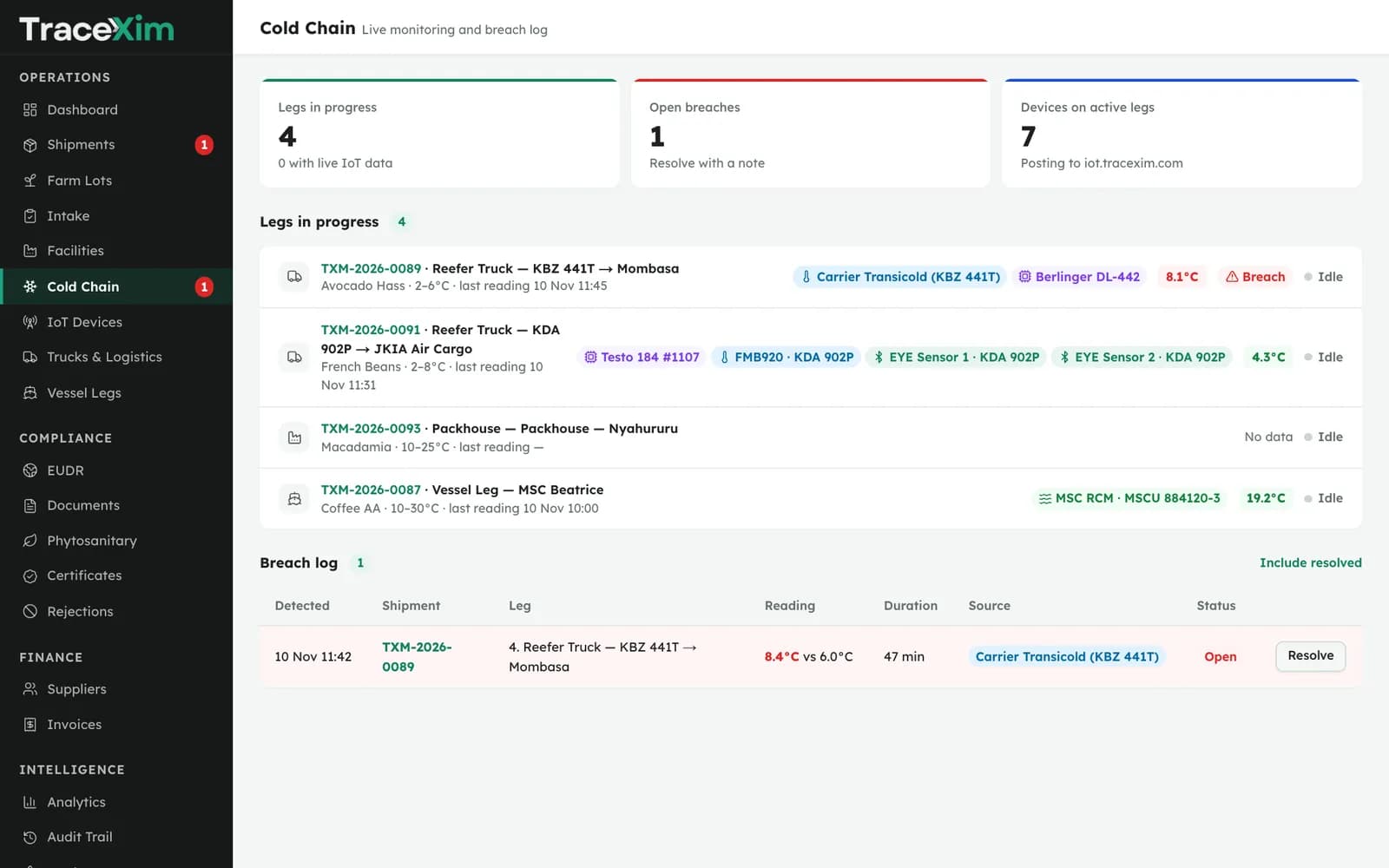
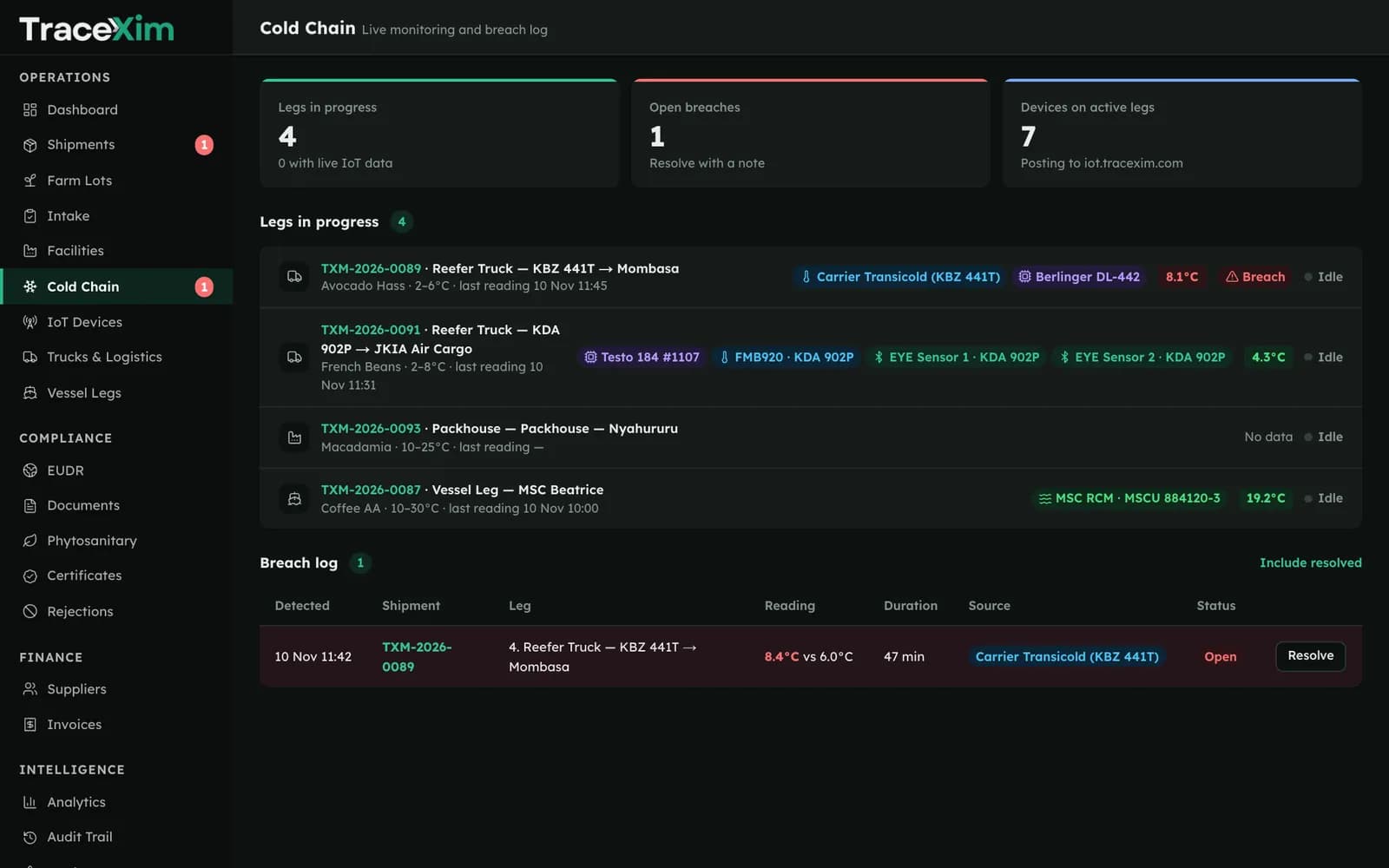
Cold chain you can prove
Loggers and trackers on every leg: farm, packhouse, reefer truck, airport and vessel. An alert goes out the minute a load leaves its range, and the full record goes in the buyer pack.
Who it's for
One place for the whole export team
The person who registers becomes the administrator, invites the team and gives each person a role. People only see what their job needs.
Export and compliance managers
See every shipment as green, amber or red, hold or release it, and produce the EUDR pack for your buyer.
Packhouse quality staff
Record intake in seconds: weight, rejects, pests and a photo. Problems show up before the lot is packed.
Field agents
Register farms, draw plots, log sprays and create lots from a phone, with or without signal.
Operations and logistics
Plan shipments and legs, track reefer trucks and vessels, and see temperature and position live.
Finance
Record purchases, issue KRA eTIMS invoices and pay suppliers by M-Pesa, with a second person approving larger batches.
Buyers, importers and auditors
Connected buyers see the shipments you share, with plot locations for their EU filing. Auditors get read-only access or an expiring link. No prices, no personal data.
EUDR
EU deforestation rules, handled with your farm records
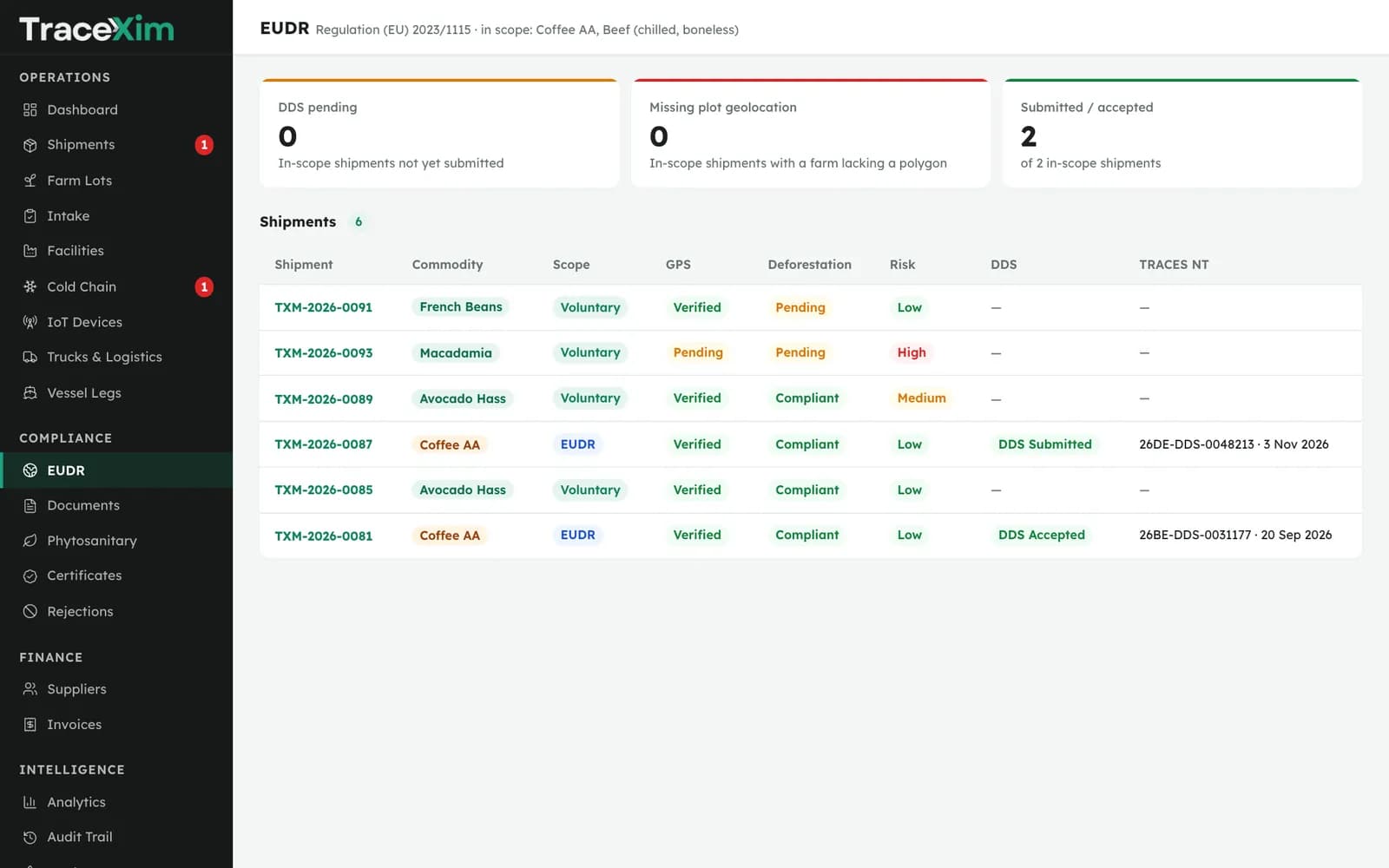
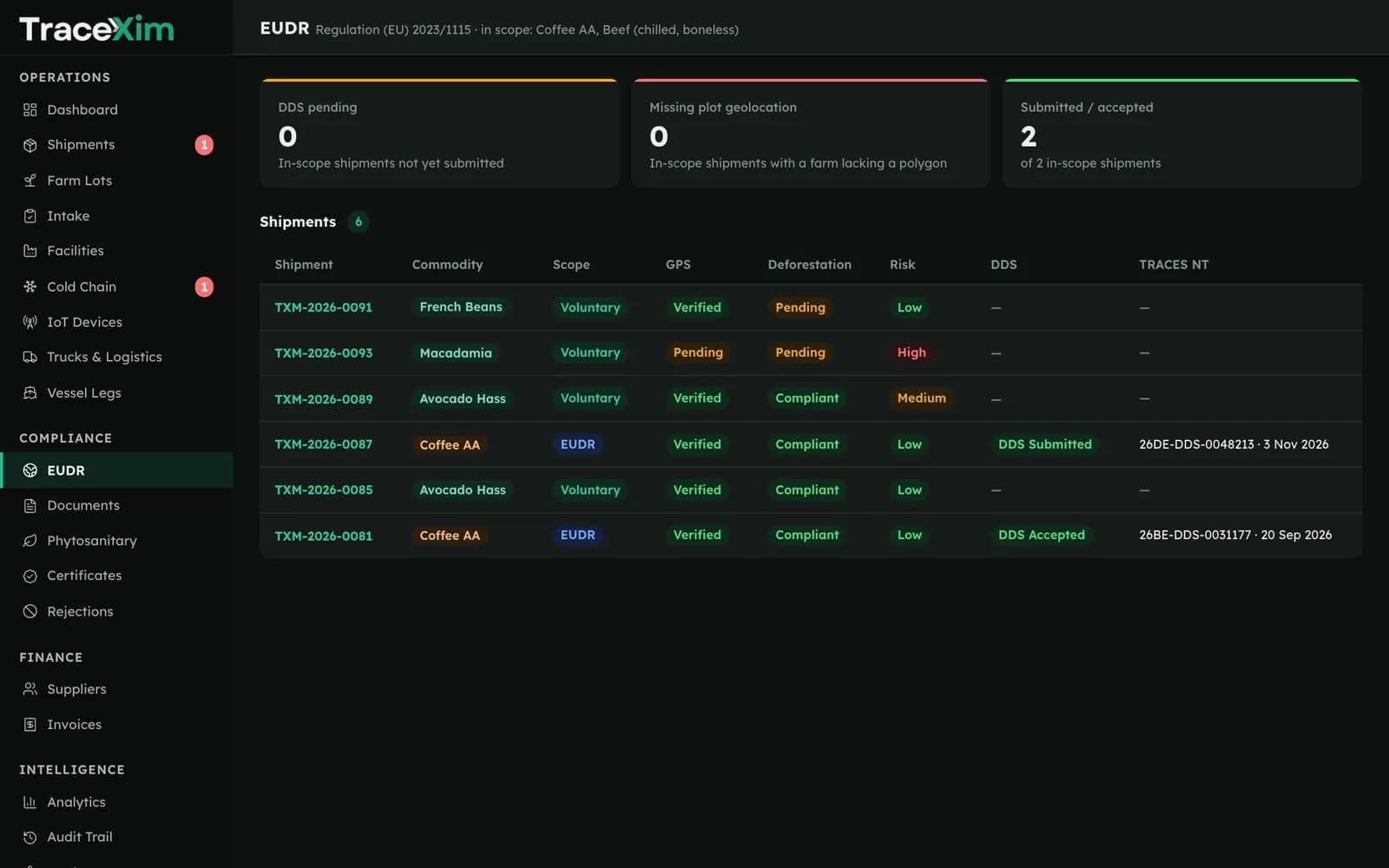
EU buyers of coffee, cocoa, soy, palm, cattle, rubber and wood must show that produce did not come from recently deforested land. TraceXim keeps that evidence with each lot, so the statement is a click, not a project.
- Draw each plot boundary on a map
- Screen plots for deforestation risk with FAO Whisp
- Keep the evidence with the lot and shipment
- Generate the due diligence statement pack for your buyer
Always confirm the final statement with your own compliance team.
For importers in Europe and Africa
See your suppliers' shipments, and file your due diligence with the evidence in hand
- Shipments your exporters share with you, with documents, cold chain and arrival time
- Plot locations as a file ready for TRACES NT, with the statement details beside it
- A due diligence file per supplier: risk assessment, mitigation steps and review dates
- Record your TRACES NT reference and verification numbers; records kept for five years
- A directory of exporters and importers with locations on a map
- Orders: tell an exporter what you need and when, and follow it to delivery
- Several delivery sites with addresses, map pins and EORI numbers
- Free during early access. An exporter can invite you with a link, no account needed to look
And more
Everything between the farm gate and your buyer
Labels buyers can scan
QR and barcode labels for every lot and shipment, with a simple public product card.
Farm scorecards
Log rejections from borders and buyers and see which farms and suppliers to watch.
Supplier payments
Purchases, eTIMS invoices and M-Pesa payouts with maker-checker approval.
Fleet and trackers
Reefer trucks, sensors and GPS trackers with live temperature and position.
Upload once, use everywhere
A certificate or lab report ticks the checklist and joins the document store and the DDS pack.
Works on the phone you have
Installs like an app, scans labels, and queues records when the signal drops.
Security and trust
Your records are sensitive. We treat them that way.
Your data stays yours
Every company's records are separated in the database itself and tested automatically for leaks.
Two-factor for the sensitive roles
Administrators and finance users sign in with a second step from an authenticator app.
Roles that match the job
From field agent to auditor, each person sees and does only what their role needs.
A record of every change
An audit trail shows who changed what and when.
Safe sharing
Share links are read-only, expire on a date you choose, and can be withdrawn at any time.
Hosted in Europe
Data is kept in the European Union and encrypted in transit. Integration keys are encrypted at rest.
Read the details on our security page, the privacy policy and the terms.
Pricing
Free while we onboard our first customers
- Every feature on this page
- No card needed to start
- We agree pricing with you before any charge
Questions
Good to know
What is TraceXim?
TraceXim is farm-to-export compliance software for Kenyan exporters and packhouses. It records harvest lots, sprays, intake checks, residue results, certificates and cold chain readings, and checks them before each shipment so problems are caught before a border or buyer rejects the produce.
Does TraceXim help with EUDR compliance?
Yes. You draw each farm's plot boundary on a map, screen it for deforestation risk, keep the evidence with the lot, and generate a due diligence statement pack for your EU buyer. Always confirm the final statement with your own compliance team.
Which crops and products does it support?
Coffee, tea, avocado, French beans, macadamia, mango, cut flowers, beef, dairy and fish are set up out of the box. You can add your own commodities, units and packaging types, with a checklist of required documents per commodity and market.
Can my team use it on a phone, with a weak signal?
Yes. TraceXim installs on a phone like an app and keeps recording at the farm when the signal drops. Entries sync when the phone is back online, and you can scan QR labels to open a lot or shipment.
Can I share records with a buyer or auditor?
Yes. You can create a read-only link that expires. It shows documents, cold chain and a due diligence pack, and hides suppliers, prices and payments.
What does it cost?
TraceXim is free while we onboard our first customers. We will agree pricing with you before any charge, and you do not need a card to start.
Where is my data kept?
In the European Union (Ireland), with the application hosted in Amsterdam. Each company's data is kept separate and only its own members can see it. You can read more on the security page.
Can my EU buyer see my shipments?
Yes. Connect with your buyer in the directory, or send them a magic link. They see the documents, cold chain, lots and plot locations for the shipments you share, and never your prices, payments or farmers' personal details. You can withdraw access at any time.
I am an importer. What do I get?
A free importer account. You see shipments exporters share with you, download the plot locations as a file for the EU's TRACES NT system, keep a due diligence file for each supplier with your risk assessment and mitigation steps, record your filing numbers, and place orders. Records are kept for the five years the regulation asks for.
How do I get started?
Create your organisation on the sign-up page, confirm your email, then invite your team and give each person a role such as field agent, packhouse QC, finance or auditor.
Ship with confidence, not with fingers crossed.
Install it on your team's phones, scan a label, and keep recording at the farm even when the signal drops.